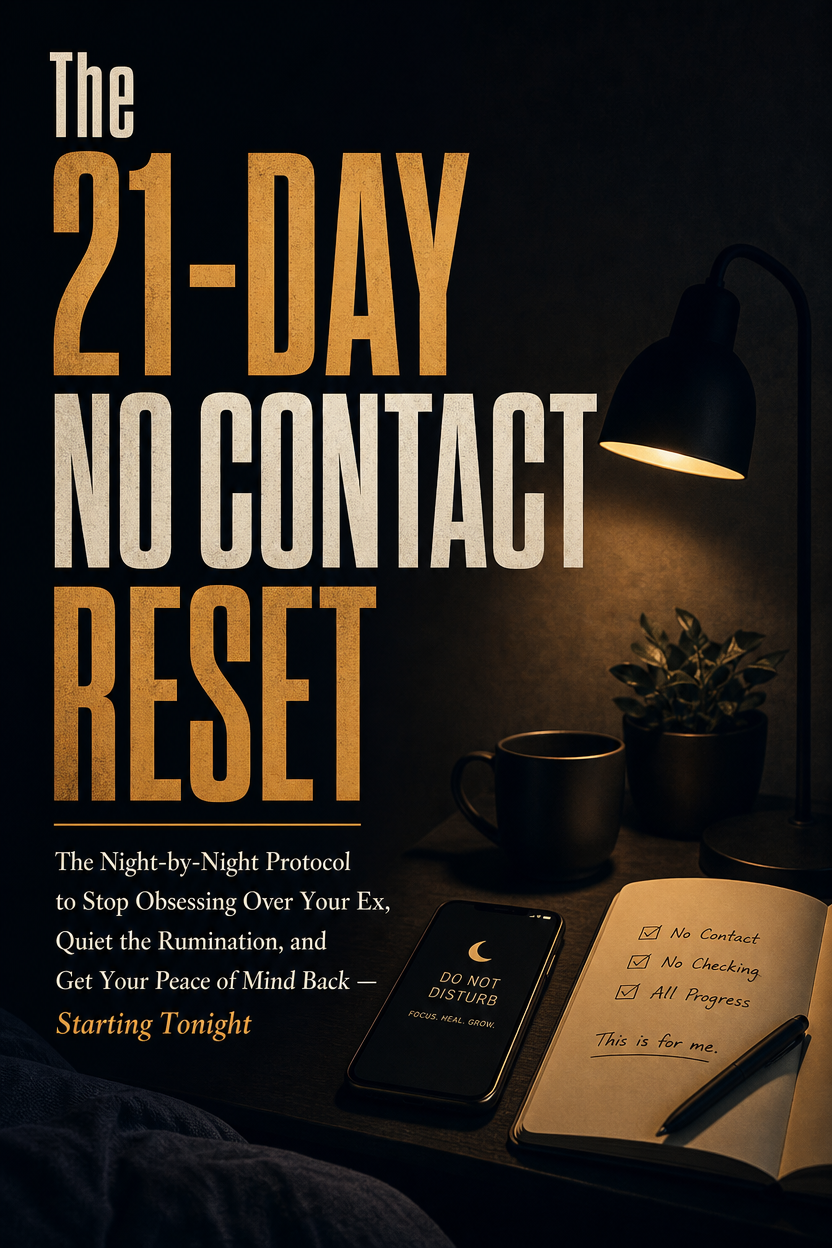
For the Person Who Just Checked Their Ex's Instagram For The Third Time Today
Stop Obsessing Over Your Ex In 21 Nights — Starting Tonight
A night-by-night protocol that kills the 1am scroll through their photos, shuts down the rumination loop, and hands your mind back — no therapist waitlist, no white-knuckle willpower.
$27 · Instant PDF download · Start tonight · 30-day full refund, no questions asked
Put the phone down. Don't open that tab.
You know the one. Their name, back in your search bar — third time this week, and it's only Tuesday.
Here's what nobody's told you yet: you don't have a willpower problem. You have a missing protocol problem.
◆
Every night, same script: how do I stop thinking about her,why is he still living in my head,why can't I just delete the number and be done. You're not weak. You're improvising something that was never supposed to be improvised.
So here's one real thing, free, before you spend a dollar: 'just don't think about it' backfires because of something called thought suppression rebound — the harder you shove a thought down, the more your brain flags it urgent and shoves it right back up. That's not a character flaw. That's your own biology, working exactly as designed, aimed at the wrong target.
Which means 'try harder' was never going to work. It's a different mechanism entirely — one we'll get to. But first you need to see why everything you've already tried never had a chance.
◆
Keep reading. Tonight's the last night you do this one alone.
011am, Phone In Hand, Again
It's late. The apartment's quiet in the way that makes your own thoughts too loud.
You told yourself you wouldn't check. You checked.
Maybe it was a text thread you reread until the words stopped meaning anything. Maybe it was their name typed into a search bar, deleted, typed again. Maybe it was just lying there running the whole relationship on a loop — the good parts first, then the part where they cheated, then the part where they told people you were the problem, and you're replaying your own humiliation like it's a movie you can't turn off.
●
You've deleted the number. You've told your friends 'I'm done thinking about it.' You genuinely mean it every single time.
And then it's 1am again and you're doing the thing.
Somewhere in there you start asking a worse question than how do I stop thinking about my ex. You start asking what's wrong with me that I can't just move on.
●
Nothing. That's the actual answer. Nothing is wrong with you. Your brain is doing something specific, measurable, and — this is the part that matters — reversible. It just needs a different kind of pressure than 'try harder' or 'give it time.'
Which brings us to why every single thing you've tried so far didn't stick. And it's not the reason you think.
02Why 'Just Get Over It' Was Never Going To Work
Meet the real culprit: the reward-craving loop
Here's the part therapists know but rarely have 15 minutes to actually explain: romantic attachment and rejection don't just feel like an addiction. Neurologically, they run through the same reward circuitry as one. Research by Helen Fisher and colleagues on the neural basis of romantic rejection found that when you lose someone, the brain regions that light up are the same ones that light up during substance craving and withdrawal.
That's why 'just stop thinking about them' feels exactly like 'just stop craving the thing you're addicted to.' Because chemically, it's close to the same ask.
So when you white-knuckle it — swear off checking their page, delete and redownload the app, go cold turkey for four days and then relapse at midnight — you're not failing a personality test. You're fighting a craving cycle with nothing but willpower, which is the one tool that has never once beaten a craving cycle for anyone, ever.
!
On top of that, there's the thought-suppression trap from a second angle: the more you try to force the memories away, the more your nervous system treats them as unfinished business — which is exactly why the dreams keep coming, why the 3am spirals feel involuntary. Because they are. You were never taught the sequence that actually interrupts the loop instead of just fighting it.
And here's the part that should genuinely make you exhale: this isn't a mystery. Attachment researchers — Bowlby, Hazan and Shaver, Levine and Heller — have mapped exactly how this loop forms and, more importantly, exactly what breaks it. It's not mysterious. It's not about being 'strong enough.' It's about doing the right things in the right order, night by night, until the craving circuit actually quiets down instead of getting poked awake every 20 minutes.
That sequence exists. You just haven't had it in front of you yet.
03The Sequence, Not The Slogan
'No contact' isn't a rule you white-knuckle. Done right, it's a detox protocol — because that's structurally what it is. You're not being dramatic when you feel withdrawal symptoms after a breakup. You're having them, the same reward pathways Fisher's research maps in romantic rejection respond to structured removal of the trigger, paired with something to replace the craving response with, the same principle behind every real habit-change model from Duhigg's cue-routine-reward loop to Clear's habit-stacking.
That's the missing piece nobody handed you: not 'stop thinking about them,' but replace the loop — remove the trigger, interrupt the rumination with a specific cognitive technique instead of vague distraction, and give the craving somewhere else to land, night after night, until the pull genuinely fades instead of just getting suppressed and coming back at 1am.
There's also a grief piece almost nobody names out loud: what you're going through maps directly onto Bowlby's stages of loss. You're not 'being dramatic' about a breakup — you're grieving, and grief has a shape, a mechanism, an order. Once you can see the shape, the chaos in your head starts to organize itself.
✓
And for the nights you're too wiped out to do anything structured at all — because let's be honest, some nights you can barely function — the sequence needs a low-energy version built in, not just a 'push through it' pep talk.
This is exactly what a therapist would map out for you if you had a real session tonight instead of a three-week waitlist: the mechanism, in order, for 21 nights. Which is precisely what got built.
04The 21-Day No Contact Reset
This is a 122-page, night-by-night protocol — not a pep-talk PDF, not a listicle. It takes the exact mechanism above and turns it into something you actually open tonight and follow.
Every night has a job: quiet a specific part of the loop, in the order your brain actually needs it quieted, backed by attachment science and CBT-based rumination interruption instead of vague 'stay strong' advice.
Inside: the Triggers Journal, so the random gut-punch moments stop feeling random and start becoming data you can actually use. The 21-Day Tracker, so you can see the loop loosening in real time instead of just hoping it's working. And a low-energy version of every single night, for when you're too drained to do the full thing but still need to not lose the day.
You don't need to feel ready. You don't need to have your life together. You need tonight, a phone, and 20 minutes.
$27 · Instant PDF download · Start tonight · 30-day full refund, no questions asked
Inside the 122 pages:
Page 14: the exact reason your brain treats a breakup like a substance withdrawal — and why that means 'just distract yourself' was never going to cut it
Chapter 4: what the no-contact rule actually is (hint: it's not what you did last time, which is exactly why it didn't stick)
Chapter 5: the Delete, Block, Mute sequence — the specific order that removes the trigger instead of just hiding it from yourself
Why 'just don't think about it' is the single worst advice you've been given (Chapter 7) — and the one-line mental move that replaces it
Chapter 6: the CBT method for shutting down a rumination spiral in under 3 minutes, mid-loop, at 1am, wherever you are
Chapter 9: what to actually do when they cheated AND told everyone else it was your fault — processing betrayal and public humiliation without losing your mind
Chapter 10: the real reason you're still dreaming about them, and the nightly habit that starts shutting the dreams down
Chapter 3: the Attachment Blueprint — why YOU specifically can't let go the way your friend did after their breakup
Chapter 12: the low-energy version of the entire protocol, for the nights you can barely get off the floor
Chapter 14: what to actually do the morning after you break and text them — and why this chapter alone will save you from spiraling into shame
Chapter 8: how grief researcher John Bowlby's stages of loss map exactly onto what you're feeling right now, and why that reframe alone brings relief
Chapter 11: what to do with your hands (and your brain) in the exact moments you'd normally reach for your phone
Chapter 13: how to turn a random 4pm gut-punch into useful data instead of just more pain
Chapter 15: the identity work most breakup advice skips completely — who you're becoming, not just who you're getting over
Page 89: the one myth about 'closure' that's keeping you stuck, and why you don't actually need it to feel better
Chapter 17: what to expect on Day 22 — because the plan doesn't just end and leave you hanging
What changes for you
Fall asleep without the replay
A specific nightly wind-down that interrupts the rumination loop before it can start, so you're not lying there running the highlight reel at midnight.
Stop the reflex check
The Delete, Block, Mute sequence removes the trigger properly, so 'just checking real quick' stops being a thing your thumb does on autopilot.
Understand what's actually happening in your head
Once you see the craving-loop mechanism, the shame of 'why can't I just move on' lifts — because you can finally see this was never a willpower issue.
Get your days back
Less time lost to spiraling means more actual hours of your life back — at work, with friends, just being present instead of half-checked-out.
A plan for the bad nights, not just the good ones
The low-energy track means even your worst, most drained nights still move you forward instead of feeling like a failure.
Stop dreading the slip-ups
Chapter 14 hands you the exact recovery move for the night you break and text them — so one slip doesn't spiral into 'I've ruined everything.'
Come out the other side as someone new
This isn't just about forgetting them — it's rebuilding an identity that isn't built around the relationship anymore.
What early readers are saying
Maria K.★★★★★
“The wind-down sequence sounds cheesy but I actually slept past 3am for the first time in weeks. My brain just... stopped looping.”
Jason T.★★★★★
“I deleted her number a month ago but my thumb still knew the way to her Instagram. The detox protocol finally gave it nowhere to go.”
Priya D.★★★★★
“Reading it was an attachment loop and not me being broken or pathetic — that's when the shame actually let go a little. Didn't expect that part to hit hardest.”
Alex R.★★★★★
“I broke on night 12 and texted him. Instead of spiraling I just followed the next-morning plan and got back on track same day. That alone was worth it.”
Every chapter, mapped to the mess in your head
01 Why This Hurts So Much (And Why It's Not a Willpower Problem)
02 Your Brain on Breakup: The Addiction No One Warned You About
03 The Attachment Blueprint: Why You, Specifically, Can't Let Go
04 The No-Contact Rule: What It Actually Is (And Why Your Last Attempt Didn't Stick)
05 Delete, Block, Mute: The Digital Detox That Actually Removes the Trigger
06 Stop the Loop: A CBT Method for Shutting Down Rumination
07 Thought Suppression Backfires: Why 'Just Don't Think About It' Makes It Worse
08 This Is Grief, Not Weakness: Mapping Your Breakup Onto the Stages of Loss
09 When They Cheated and Then Told Everyone Lies: Processing Betrayal and Public Humiliation
10 Why You're Dreaming About Them and Why You Can't Sleep
11 Replacing the Habit: What to Do With Your Hands (and Brain) Instead
12 Too Drained to Do a Program? The Low-Energy Version of Everything
13 The Triggers Journal: Turning Random Pain Into Useful Data
14 The Slip Isn't the Failure: What to Do the Morning After You Text Them
15 Rebuilding You: Identity After the Relationship
16 The Tracker: Running Your Full 21 Days Day-by-Day
$27 · Instant PDF download · Start tonight · 30-day full refund, no questions asked
A single session with a therapist who actually specializes in breakup recovery runs $150 to $250 — and that's if you can get on the calendar inside of three weeks.
This is $27. One session's worth of insight, minus the waitlist, minus the calendar, available tonight instead of next month.
Compare it to the actual cost of staying stuck: another week of bad sleep, distracted workdays, the 1am scroll sessions that leave you more wrecked than the night before. That's not free. That's just an invisible price you're already paying.
There's no subscription, no upsell chain, no '12 easy payments.' One PDF, 122 pages, yours the second you buy it.
$27 to stop the loop tonight, or another week of doing this exact thing for free. That's really the comparison.
✓
If It Doesn't Quiet The Thoughts, You Don't Pay
Go through the protocol. If it doesn't help you quiet the obsessive thinking, email contact@blacknovaads.com within 30 days and you'll get a full refund — no questions, no forms, no guilt trip. This isn't backed by ten thousand testimonials. It's backed by the mechanism inside it, and a guarantee that makes trying it completely risk-free.
You're probably thinking…
Will a PDF actually do anything when venting to friends and going cold turkey haven't worked?
Venting and cold turkey were never structured — they're just willpower with extra steps. This is a sequenced protocol built from the actual mechanism behind the craving loop, night by night, so you're not relying on grit alone. That's the difference between a coping tactic and a plan.
I've done no-contact before and it didn't stick — why would this time be different?
Because last time you probably had the rule without the mechanism — you knew not to text them, but nobody showed you what to do with the craving that made you want to. Chapter 4 specifically covers why your last attempt fell apart, and builds the missing piece in.
I'm too emotionally drained to commit to a whole 21-day program right now
You don't need full energy to start — that's Chapter 12. Every single night has a low-energy version built in, so on the nights you can barely function, you still do something instead of nothing. Tonight only takes about 20 minutes.
Isn't this just a fancier version of 'time heals all wounds'?
No — time without structure is just more nights of the same loop. This gives the loop somewhere to go instead of just waiting it out, which is the whole reason it's night-by-night instead of 'eventually you'll feel better.'
What if I'm not 'that bad' — is this overkill for a normal breakup?
If you're googling how to stop thinking about your ex at 1am, this was built for exactly that. It's not clinical treatment — it's the structured version of what you're already trying to do on your own.
How do I know this isn't just recycled internet advice in a PDF wrapper?
Every mechanism inside is grounded in named, real research — Fisher's work on romantic rejection and reward circuitry, Bowlby on grief, Levine and Heller on attachment — not vague vibes. You can check every citation yourself.
There are two versions of tonight.
In one, it's 1am and you're doing the thing again — the scroll, the replay, the same question with no new answer. Tomorrow looks like today looked like yesterday.
In the other, you open this tonight instead. Night One doesn't ask you to be strong. It just asks you to follow the sequence — and as you start following it, you'll notice something you haven't felt in a while: quiet.
→
You don't need to feel ready for this. You just need to start it. The version of you on Day 21 already knows that.
This is the plan nobody handed you when you needed it most. It's yours now — starting whenever you're ready to open it.
Every night you don't have a plan is another night the loop runs on autopilot — the cost isn't a deadline, it's just another 1am you didn't have to spend this way.